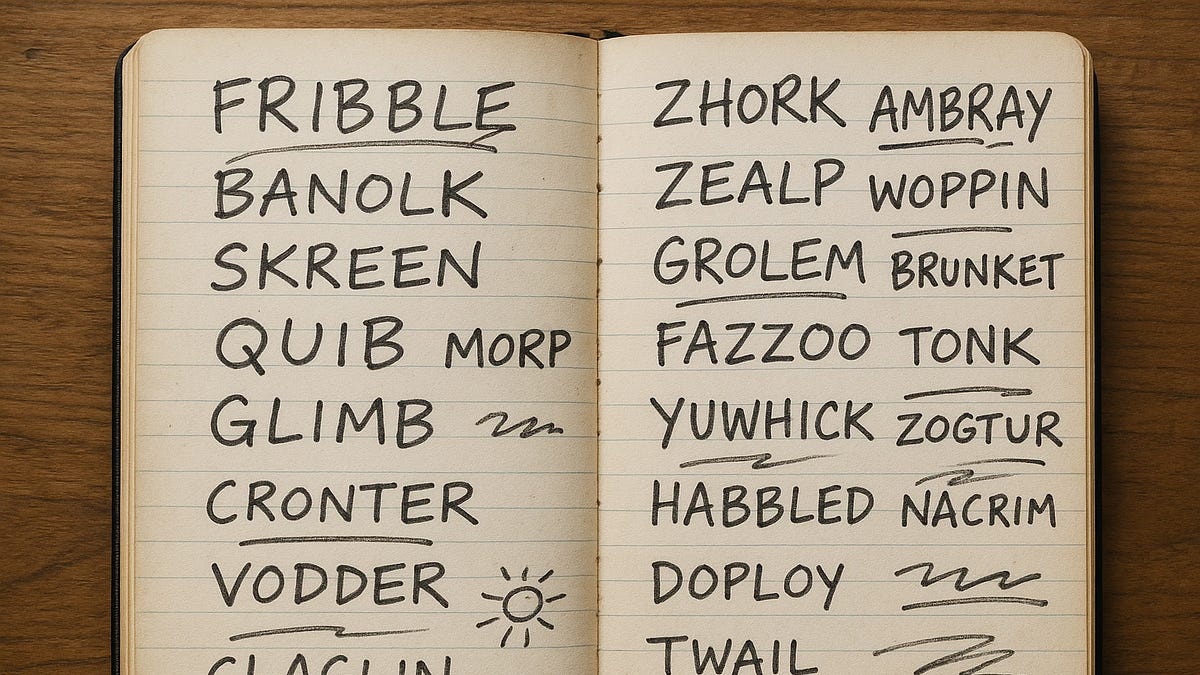
Recently I’ve been writing songs made entirely of nonsense words not placeholders, but syllables and sounds that feel like they should mean something. Words that resonate. Words that have rhythm, tone, presence even if they don’t (yet) appear in a dictionary.
It’s part of a new (very hush-hush) project we’re developing. And it’s taken me into strange, beautiful territory a kind of dream-language where music and speech dissolve into something more experiential, in many ways a natural connection with my improvisational roots. its a kind of creative semantics: a process where invented language becomes meaningful through sound and structure. These words carry emotional weight. They feel familiar and sound real sometime more than real!
Thanks for reading The Quiet Room! Subscribe for free to receive new posts and support my work.[
](https://substackcdn.com/image/fetch/$s_!hB-C!,f_auto,q_auto:good,fl_progressive:steep/https%3A%2F%2Fsubstack-post-media.s3.amazonaws.com%2Fpublic%2Fimages%2F16e4bcec-e1da-4a00-aecc-6c298f3b76e5_1028x754.png)
This isn’t new. In 1972, Italian singer Adriano Celentano released Prisencolinensinainciusol, a hit single written entirely in gibberish. He designed it to sound like American English, mimicking its rhythm and flow without saying anything at all. But it worked - The song's cadence communicated something universal. Celentano said it was about “the inability to communicate” but ironically, the song became a sensation because of how clearly it connected and is currently enjoying a viral revival.
That’s the paradox I love: what appears nonsense somehow makes sense.
Language is always becoming
Language isn’t fixed, it’s alive. New words emerge from slang, from memes, from subcultures and street corners. A recent viral video shows a professor decoding Gen Z slang in real time to a group of students. It’s playful, theatrical, but surprisingly revealing. He throws out lines like:
“I’m feeling so locked in, this is literally fire vibes, no cap.”
“We gotta secure the bag get those wins, hit different.”
“Periodt this moment’s iconic.”
To older ears, this might sound like a different dialect altogether. But for his audience, it’s instantly legible emotionally and culturally fluent. It’s not just what the words mean, it’s how they’re said, when they’re said, who is saying them. Meaning is carried not just by definition, but by vibe, rhythm, performance, and repetition.00000000
Words like “rizz,” “bussin’,” and “the ick” started informally. Now they’re in dictionaries. The language we use becomes the language we have and it happens fast - in fact ever faster in the connected age.
So why shouldn't a made-up word be just as valid? If it’s repeated, shared, and understood then is should be valid - essentially language doing what it has always does: evolving through use.
Sound First, Meaning Second
Music is its own kind of language. Not just a series of notes or lyrics, but a system of emotional logic of memory, anticipation, timing, and texture. And like spoken language, repetition gives it weight.
Brian Eno captured this beautifully in his work with ambient music. He once said:
“Repetition is a form of change.”
In albums like Music for Airports, he layered tape loops of different lengths some repeating every 23½ seconds, others every 25⅞ seconds, so they would drift in and out of sync. The result was music that seemed still, but was in constant evolution.
“It created a sort of landscape you could belong to.”[
](https://substackcdn.com/image/fetch/$s_!fi_8!,f_auto,q_auto:good,fl_progressive:steep/https%3A%2F%2Fsubstack-post-media.s3.amazonaws.com%2Fpublic%2Fimages%2Ffad458ed-0a78-43ae-b11a-90b0ac77507c_512x512.png)
What began as raw fragments recordings of ephemeral, even mundane sound became a kind of sonic architecture. The more it looped, the more we heard in it. We began to anticipate its contours. We felt a kind of emotional logic take shape. once that logic is internalized, any deviation feels wrong. Not because it’s musically incorrect, but because it disrupts a pattern our brain has started to trust.
That’s the power of repetition. It transforms chaos into structure.
This happens in pop music too. A hook that initially sounds random becomes addictive through exposure. The beat hits at the right moment. The line lands where it’s supposed to. It becomes true through sheer familiarity.
It even happens with film music. As a composer, I’ve watched editors fall in love with temp tracks the temporary music used to cut early scenes. Maybe the music isn’t perfect. But it’s familiar. They’ve heard it 100’s of times. They know where the rises and falls hit. Suggest something else even something better and it doesn’t feel right. It feels “off.” Because the brain has already made a map.
We make meaning. Over time. Through loops and resonance. Through pattern and recognition.
This isn’t just an aesthetic phenomenon it’s survival logic. We are pattern-seeking creatures and fundamentally wired to make sense of sound and rhythm. So we attach feeling to familiarity and always anticipating. And in that process, even a nonsense word repeated often enough with rhythm and feeling starts to feel like a its meant to be.
Not because we know what it means.
But because we believe it does.
From Cage to Bradbury: the art of letting go
This isn’t just pop psychology, it’s deeply embedded in the history of experimental art.[
](https://substackcdn.com/image/fetch/$s_!Qbk8!,f_auto,q_auto:good,fl_progressive:steep/https%3A%2F%2Fsubstack-post-media.s3.amazonaws.com%2Fpublic%2Fimages%2F67b1f4f4-4732-40cc-b2ca-4feb5a85bbce_591x728.jpeg)
William Burroughs created cut-up texts, shuffling syntax into new configurations that still somehow spoke.
John Cage used the I Ching to randomise his musical structures, welcoming chance as part of the message.
In his iconic Lecture on Nothing, Cage wrote:
“I have nothing to say and I am saying it and that is poetry.”
It’s a line I keep coming back to. Because it reframes the whole idea of content. Meaning doesn’t need to be explicit. It can emerge from structure, rhythm, placement. Saying the thing is the thing.
Ray Bradbury, too, talked about writing as an act of improvisation. He’d chain words together like stepping stones one word leading intuitively to the next. The story didn’t exist before. It emerged in the flow.
That’s how nonsense words feel in songwriting: improvised utterances that become language over time.
I sometimes think of it as semantic fractalization a kind of spiralling, layered resonance that makes its own logic, not from meaning but from form and context.
Listen to a demo track I wrote for a Dance project that never happened - inspired by Cages lecture on nothing -
Nonsense, but not meaningless
Our brain is always attempting to make meaning out of sensory stimulus - we will find the connections - Its one of the things I love most about scoring soundtracks - those moments of serendipity - its at the core of how sound works with music. The edge between sound and sense
And through that process, we build language which starts as noise.
- nonsense word becomes poetry.
- a loop becomes music.
- a made-up language starts to mean something real.
sometimes the most powerful thing you can say…has no words yet, So you make them up, You sing, You let the sound speak for you.
And that, I think, is enough.
Thanks for reading The Quiet Room! Subscribe for free to receive new posts and support my work.