Tuning the Instrument: How Consciousness and Cognitive Reserve Become the Real Longevity Stack
Lately I have been thinking about ageing. Not in the grim or medical sense, but in the quiet way you start to notice yourself shifting. One month you are sprinting through projects and ideas and the next you wake up with a new ache or a sudden moment of clarity. It feels as if something in the background has rearranged itself.
The Guardian ran a piece this week suggesting that we do not age in a straight line. The body appears to move through distinct phases. Research from Stanford has identified what they describe as molecular precipices. These are points where your biology changes direction very quickly. The most notable shifts appear around age forty four and again at sixty.
Thanks for reading The Quiet Room! Subscribe for free to receive new posts and support my work.
Oddly enough, I find this comforting. It suggests that ageing is not a slow unraveling. It is a series of transitions.
This made me reflect on my own behaviour. The keto routine, the running, the supplements, the careful attempt to stay healthy without losing the joy in life. On the surface it looks like optimisation, but it feels more like something deeper.
I think what I am really doing is tuning the instrument. I am trying to keep the signal clean.
I have always been drawn to the Silicon Valley optimists. People like Dave Asprey and Peter Diamandis speak about abundance and human potential in a way that feels expansive. It resonates with my sense of what technology can do for us and with my underlying belief that we are capable of far more than we imagine.
There is scientific grounding for this outlook. Research from Yale, led by Becca Levy, shows that positive age beliefs can extend life expectancy by more than seven years. Your mindset becomes a biological mechanism.
This fits naturally with how I experience consciousness. I experience it as something larger and more fluid than the biological frame that carries it. I relate to the Eckhart Tolle sense of presence and to the idea that awareness itself shapes the path ahead.
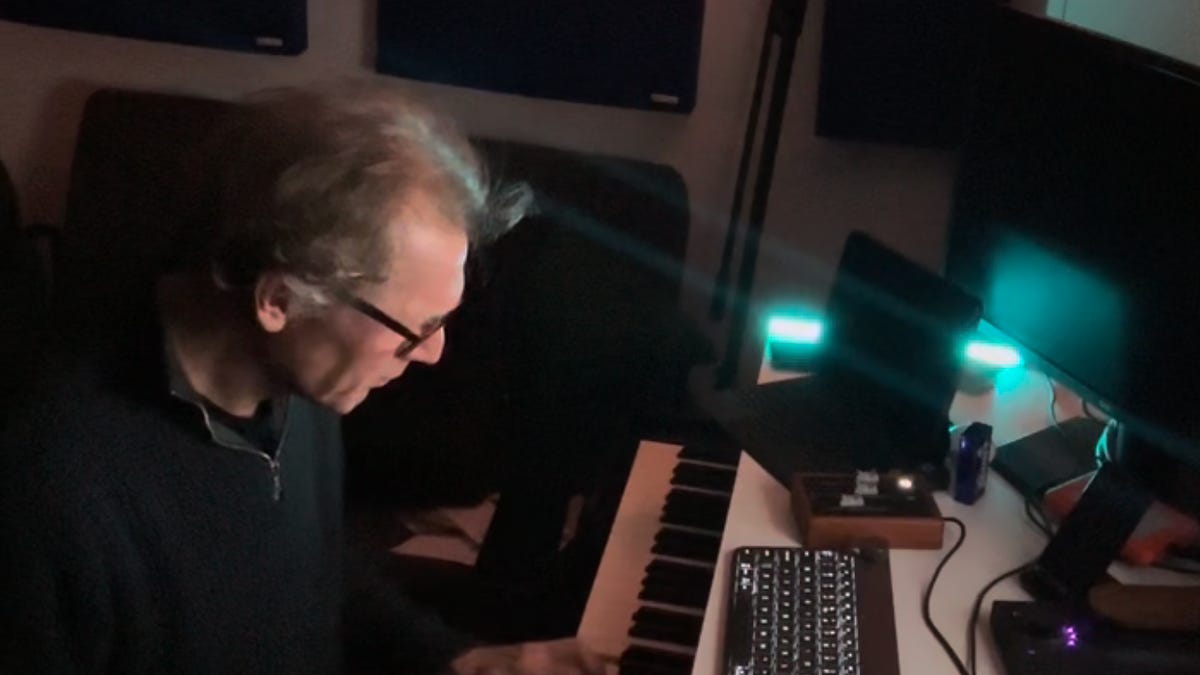
Music is where this becomes real for me. It is my emotional architecture. When I sit at the piano something shifts. Neuroscientists describe this as cognitive reserve and they talk about musical practice building new neural pathways and protecting white matter integrity. My experience is more immediate. One moment I am scattered. The next I feel as if I have stepped inside a structure I did not realise I was building. Everything aligns.
So I will keep running and refining the diet and the habits. Not to outrun ageing but to meet each phase clearly. I want to be well enough and present enough to create the next piece of music. I want to be able to step into each transition with clarity rather than resistance.
If life really does unfold in sudden turns then I want to be awake when they happen. And I want the piano nearby.[
](https://substackcdn.com/image/fetch/$s_!dQn6!,f_auto,q_auto:good,fl_progressive:steep/https%3A%2F%2Fsubstack-post-media.s3.amazonaws.com%2Fpublic%2Fimages%2F14671fd5-fd73-449c-99fe-baeeb1918d36_924x922.png)
Research Referenced for Context
Music as Brain Architecture
Research on cognitive reserve and neuroplasticity, including studies showing that musical training strengthens neural pathways, supports the executive control network, and maintains white matter integrity in the corpus callosum.
The Non Linear Ageing Study
Shen, X., et al. (2024). Nonlinear dynamics of multi omics profiles during human aging. Nature Aging.
This is the Stanford work that identified distinct biological inflection points around ages forty four and sixty.
The Power of Mindset
Levy, B. R., et al. (2002). Longevity increased by positive self perceptions of aging. Journal of Personality and Social Psychology.
This research shows that positive age beliefs influence biomarkers and can extend lifespan.
Thanks for reading The Quiet Room! Subscribe for free to receive new posts and support my work.