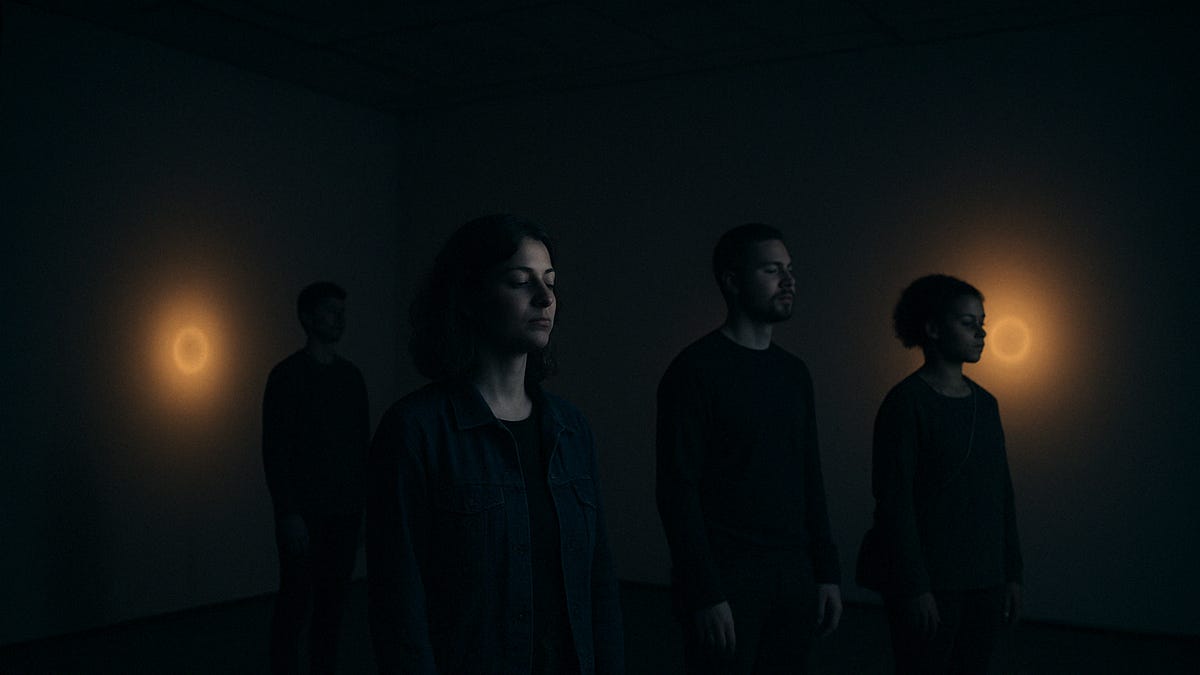
There’s a moment I wait for in every piece I compose, every immersive installation, every spatial performance, every sound-driven experience that begins with some cables and a blinking interface. It’s subtle, but unmistakable. The room begins to dissolve.
The Quiet Room is a reader-supported publication. To receive new posts and support my work, consider becoming a free or paid subscriber.
Not visually, but sonically.
The gallery walls don’t fall away, but something in the air shifts. People stop fidgeting. Their heads tilt. Breathing slows. You can see it in posture, feel it in silence: the sound has arrived, and it has claimed the space.
They’re not looking anymore, they’re listening. Or rather, they’re being listened to by the sound itself.
This is the magic of immersive audio.
And the thing is, we’re just getting started.
Listening with the Whole Body[
](https://substackcdn.com/image/fetch/$s_!CCxX!,f_auto,q_auto:good,fl_progressive:steep/https%3A%2F%2Fsubstack-post-media.s3.amazonaws.com%2Fpublic%2Fimages%2F426628cd-36ca-4892-b892-be035a7f4bc0_1400x1400.heic)
Sound, when it wraps around you, doesn’t stay in the ears. It settles in your bones. In the nervous system. In the animal part of you that predates language and reason. It’s not passive, it’s architectural. It builds a world around you, sometimes before you realize you’ve entered it.
This is what spatial sound, ambisonics, binaural recording, Dolby Atmos, or whatever acronym we use next, is uniquely good at. It doesn’t just tell a story. It places you inside one.
In a rainforest soundscape, we don’t just “hear” birdsong. We relax. We trust the world again. A whisper from behind triggers vigilance. The body tenses, adapts. A drone that slides past us, circling, becomes thought itself, unspoken but understood.
Immersive audio is not a garnish. It is presence. It is the feeling of being somewhere, not just observing it from behind a screen.
And for me, the most exciting part is that it’s not about more, it’s about closer.
Closer to emotion.
Closer to sensation.
Closer to the thing itself.[
](https://substackcdn.com/image/fetch/$s_!XdD-!,f_auto,q_auto:good,fl_progressive:steep/https%3A%2F%2Fsubstack-post-media.s3.amazonaws.com%2Fpublic%2Fimages%2F36c53f84-79a8-4ec5-ab87-f96f4cd794b6_2000x608.heic)
The Invisibility Problem
And yet, sound, despite all of this, remains strangely sidelined.
We live in a time when audio tech is more accessible than ever. Dolby Atmos is on our phones. Binaural mics are sold on Amazon. DAWs offer plug-ins that let you place sound in a simulated 3D field with just a drag of the mouse.
But if you look at where the energy, and the money, is going in immersive media, it’s still overwhelmingly visual.
The immersive mixing system I use, one that lets me move sound objects in virtual space like sculpture, was recently discontinued. Absorbed by a larger company. Stripped of updates.
Meta, Apple, Sony, they speak of spatial computing and extended reality with reverence, but mostly through lenses. Retina displays. Hand tracking.
But what about the sonic imagination?
Why is it that sound, which reaches us so deeply, continues to be treated as an accessory to vision? Why do we build worlds with our eyes and only decorate them with our ears?
The answer, I suspect, is both cultural and cognitive.
We are a visually dominant species living in a hyper-visual age.
Screens. Clips. Photos. Filters. Stories. Reels. Even our memories are now cropped and color-graded.
Sound is harder. It’s harder to sell. Harder to screenshot. It doesn’t go viral.
And perhaps most threatening of all, it doesn’t ask for your attention so much as your presence.
And presence, in an era of relentless content, is harder and harder to afford.[
](https://substackcdn.com/image/fetch/$s_!u-I1!,f_auto,q_auto:good,fl_progressive:steep/https%3A%2F%2Fsubstack-post-media.s3.amazonaws.com%2Fpublic%2Fimages%2F916c4e6d-498d-4214-a851-2d87c27ad67e_1400x1400.heic)
You Can Close Your Eyes, But…
You can’t close your ears.
That’s one of sound’s deepest truths.
You can try to block it, dampen it, tune it out, but it’s still there. Air vibrating. Pressure shifting. Information arriving at the body whether you want it or not.
This is what makes immersive sound such a potent storytelling tool, and also why it's undervalued.
Sound doesn’t just inform. It infiltrates.
And because of that, it's difficult to measure. You can’t always trace what it did to someone. You just know that something changed.
In our algorithmic culture of metrics and ROI, this makes sound deeply inconvenient. It doesn’t perform in the way we’re taught to expect performance.
It doesn’t fit into a content strategy deck.
It lingers, instead.
It haunts.
It becomes memory.
Sound as a Way of Knowing
Think about this: before we had language, we had rhythm. Before paintings, we had chants. Before gods had faces, they had voices.
Sound was our first medium.
A baby knows the world first by sound. By heartbeat. By tone. A lullaby carries more security than the brightest mobile dangling from the crib.
In fact, sound is often the signal that a space is alive.
You walk into an unfamiliar room. You don’t scan it, you listen to it. How does it echo? Who’s speaking? Is it quiet in the way that signals danger or in the way that feels safe?
We treat sound as a footnote, but in truth, it’s the whole sentence.
If you strip visuals from a film, you get abstraction.
If you strip sound, you lose the story.
The Emotional Topography of Immersive Audio
This is the part that keeps me up at night, because it excites me more than it frustrates me.
Immersive sound doesn’t just add detail, it sculpts feeling.
Tension, intimacy, suspense, joy… all of it can be dialed in spatially.
A breath in the left ear. A distant rumble below your feet. A melody that swirls from behind, reaches the center, and then dissipates.
We can make a space feel sacred. Or haunted. Or like the inside of someone’s head.
With the right tools, we can map emotion. Not abstractly, but physically.
It’s not about volume or fidelity. It’s about proximity. Direction. Presence.
And yet, the tools we rely on are often fragile.
Underfunded. Unsupported. Tacked on as “advanced features” rather than treated as core architecture.
If sound is the soul of immersive storytelling, then why do we keep designing worlds without heart?[
](https://substackcdn.com/image/fetch/$s_!rlCv!,f_auto,q_auto:good,fl_progressive:steep/https%3A%2F%2Fsubstack-post-media.s3.amazonaws.com%2Fpublic%2Fimages%2F223f3ba7-6427-4a14-83a6-7b8a51fe8a91_1400x1000.heic)
The Coming Shift
Still, I’m not pessimistic.
In fact, I think we’re on the cusp of something extraordinary.
Because visual culture is nearing saturation. The screen has reached its limits. HDR and 8K and ultra-slim OLEDs don’t move us the way they used to.
What do we crave instead?
Presence. Stillness. Meaningful immersion.
People are listening again.
To ambient records. To sound baths. To 10-hour looped rainstorms. To podcasts that don’t just deliver information but create an atmosphere.
We’re remembering what it means to be in sound, not just to consume it.
Immersive audio isn’t a gimmick, it’s a recalibration.
It’s a way to bring the body back into the story. To remind ourselves that we don’t just watch a narrative. We inhabit it.
What Comes Next
To get there, we need support.
Not just applause for sound designers, but real investment in the infrastructure that allows sound to lead, not just follow.
We need tools that are intuitive, reliable, and expansive.
We need collaboration between directors, composers, technologists, not handoffs where sound is added in post like an afterthought.
We need studios, platforms, and creative cultures that believe sound is the story, not just the soundtrack.
Because when we give sound the space to be what it truly is, something remarkable happens.
We don’t just hear.
We feel seen.
To accompany this piece, I’ve curated a listening companion: a selection of immersive tracks that echo the emotional and spatial textures explored here. These aren’t background songs, they’re environments. Each one invites you to slow down, lean in, and feel sound as something more than sound. Best experienced on headphones, alone, when the world is quiet enough to let the story arrive through your skin.
Giles Lamb is a composer and sound designer working across film, games, immersive installations, and media art. He believes sound is the original immersive medium, and that the future of storytelling will be heard before it is seen.
The Quiet Room is a reader-supported publication. To receive new posts and support my work, consider becoming a free or paid subscriber.