Giles Studio - Where the Magic Happens
I used to come home from school and go straight to the piano.
Not because I was disciplined or particularly virtuosic or even especially good. I went because that old upright was the one place where the world made sense. My fingers could ramble without consequence, my thoughts could loosen, and something call it resonance, call it therapy, call it stillness would settle in the room like dust. It didn’t matter that school was chaos, or that I never quite found my place among classmates or cliques. I had sound. I had keys. I had a kind of freedom.
The Quiet Room is a reader-supported publication. To receive new posts and support my work, consider becoming a free or paid subscriber.
And then there was the other kind of keyboard, the one with blinking LEDs and plasticky drum pads.
It was the 80s. My room held a ZX Spectrum with a sampler, a Casio CZ5000, and a drum machine that sounded like a vending machine having an emotional breakdown. I was utterly, deliciously obsessed. This was my creative sandpit. Inspired by Vangelis especially Chariots of Fire I’d try to build whole worlds out of 8-bit limitations and synth presets that felt like spaceships trying to hum lullabies. I didn’t make anything remarkable, but that wasn’t the point. I was playing. Experimenting. Building invisible cathedrals out of ones and zeroes.
It was, I think, the first time I understood what technology could mean for expression.
The Myth of the “Real” Instrument
There’s a kind of reverence we attach to acoustic instruments. And I get it. Sit at a real piano let the strings vibrate, let the soundboards sigh and you’re communing with something ancient. Something wood-and-felt, something alive. I’ve felt that magic. Still do.
But I think we’re too quick to dismiss the emotional weight of a blinking cursor. Or the beauty of a well-designed controller. Or the quiet thrill of hearing a virtual violin cry under your fingertips, not because you bowed it right, but because you mapped touch data to expression curves in a way that made it feel like you did.
I’m not interested in pitting real against virtual. I think that’s a false binary. What I care about what I’ve always cared about is expression. The feeling that what I’m doing in the physical world (a press, a stroke, a gesture) is being translated no, transmuted into something that feels true. Honest. Felt.
Enter: The Machines
Fast forward a few decades, and my studio looks very different. I don’t have a room full of keyboards anymore (though god, I wish I’d kept them all). My setup now minimal in organised chaos kind of a way: a high-end weighted keyboard controller, an iMac, a few essential pieces of gear. But within that stripped-back space lives an entire orchestra of potential.
Take Pianoteq, for example a modelled piano that doesn’t use recordings at all. It’s not playing back samples; it’s simulating the actual behavior of sound waves and wood and metal. In some ways, it’s more alive than any sampled piano I’ve ever played. It breathes with me. It surprises me. And when I use an MPE (MIDI Polyphonic Expression) keyboard (I use a Kieth MacMillan, not the nicest keyboard but does the job!). where you can bend and slide and press in three dimensions it becomes an entirely new instrument. One that listens. One that feels.
I use a Touché controller a beautifully machined piece of walnut that responds to the smallest movements and pair it with Arche modelled string instruments. When it’s all working together, it feels like sculpting sound out of air. No, it doesn’t always sound like a “real” cello. But sometimes it sounds like something better a voice I didn’t know I had access to.
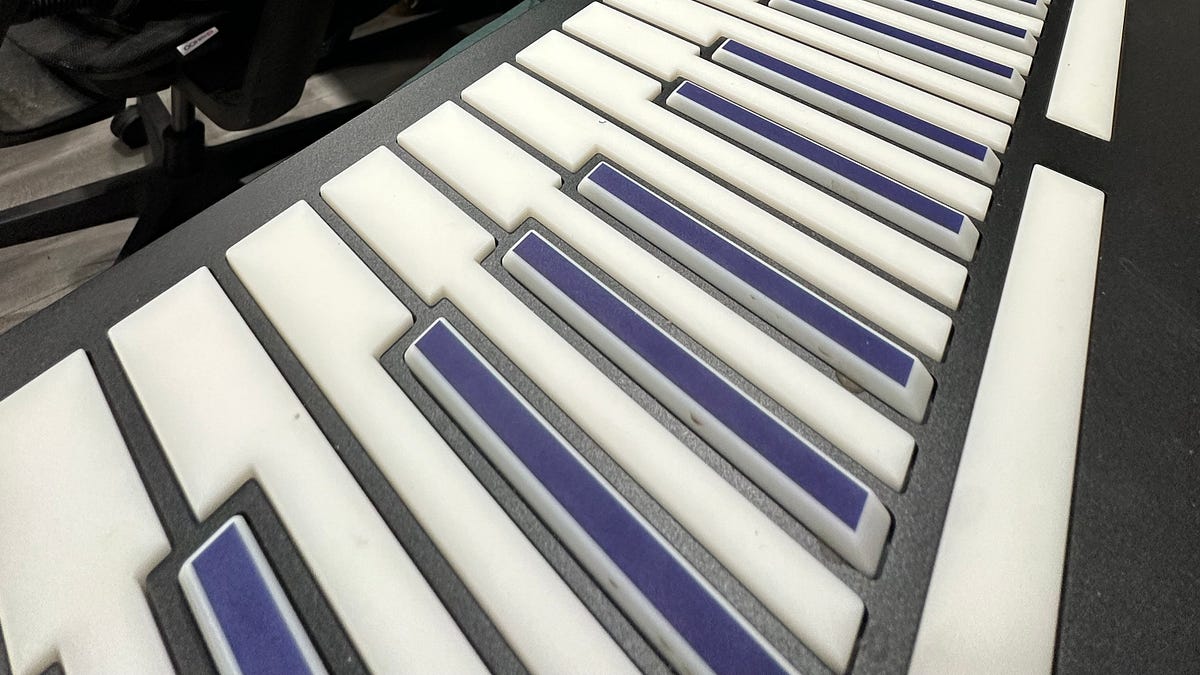
My dream is to have the Haken Continuum which is a neoprene strip (of the wetsuit variety) with keys printed on the surface and an array of sensors embedded under the surface which when controlling the eagan matrix, a kind multimodal 3d synth, reponds to every nuance and movement - it truly feels like a living breathing musical instrument (from the future). Hans Zimmer collaborated with Haken using their intruments on the latest Dune 2 score [
](https://substackcdn.com/image/fetch/$s_!g_un!,f_auto,q_auto:good,fl_progressive:steep/https%3A%2F%2Fsubstack-post-media.s3.amazonaws.com%2Fpublic%2Fimages%2F1765354f-29b6-4ac8-b46b-8417dd8d84a5_1280x720.heic)
Tools as Portals
What I’ve come to believe is this: the best creative tools are not the most accurate, or even the most realistic. They’re the ones that make you feel like you’re in conversation with your own imagination. The piano did that for me when I was twelve. The ZX Spectrum did that too, in its crunchy, glitchy way. And now, it’s these new instruments these physical-digital hybrids that are rekindling that feeling again.
Because when the technology gets out of the way when it stops being a barrier and starts being a portal something beautiful can happen. We can stop chasing perfection, and start chasing expression. We can stop imitating, and start inventing.[
](https://substackcdn.com/image/fetch/$s_!W6y4!,f_auto,q_auto:good,fl_progressive:steep/https%3A%2F%2Fsubstack-post-media.s3.amazonaws.com%2Fpublic%2Fimages%2F3bfe238e-ea2b-4aa4-a95d-a8adc43f93d1_447x312.heic)
What If This Is the Golden Age?
There’s a narrative that everything is getting worse. That screens are stealing our attention, that AI is killing creativity, that analog was real and digital is just a sad simulation. And some days, I buy into it. Some days I want to hurl my phone into a river and record an ambient album with sticks and rocks.
But other days good days I sit at my keyboard, open a blank session, and feel that old familiar feeling. That wonder. That stillness. That sense that this, whatever it is, is enough. That the machine is not cold, or sterile, or soulless. That it’s just another kind of piano. Another kind of sandpit.
And I get to play again.
What about you?
What tools are your portals? Where do you go digitally, physically, emotionally when you need to hear yourself again?
Let’s keep building invisible cathedrals. One key, one click, one strange new sound at a time.
The Quiet Room is a reader-supported publication. To receive new posts and support my work, consider becoming a free or paid subscriber.