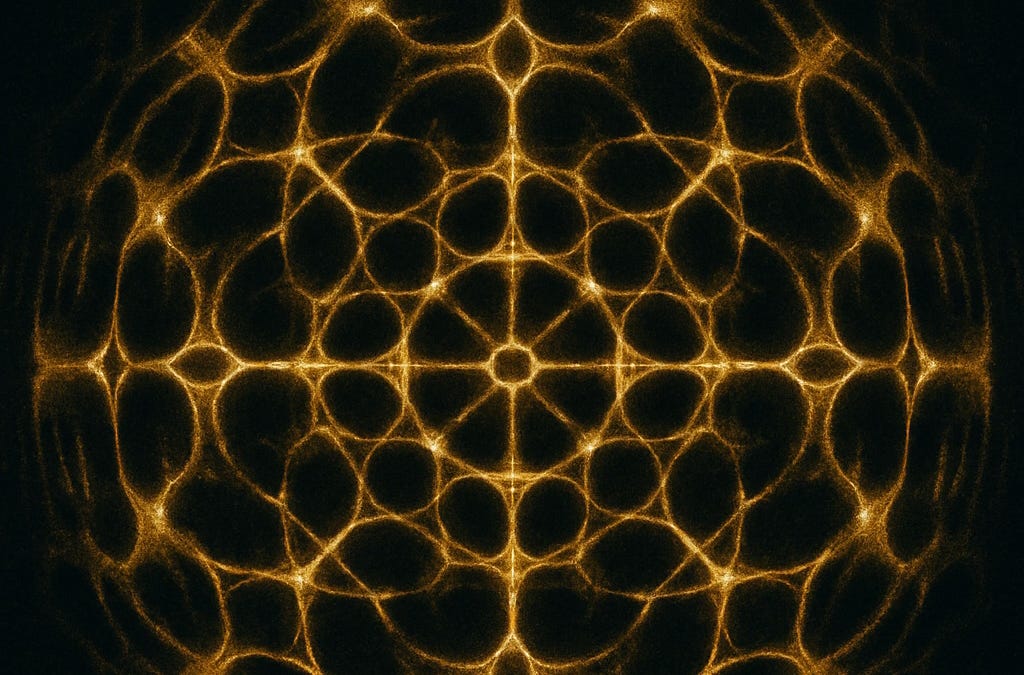
A generative Cymatic frequency pattern
The Resonance of Everything
A creative philosophy for now
Introduction
After a visit to the Tate Modern where a few exhibits had sound as their center of gravity I found myself drifting into familiar territory. As a sound designer and composer, I’ve worked on museum installations before, and sound is always the unruly guest. You can’t box it up. It spills, seeps, echoes. It’s everywhere and nowhere. But something lingered with me after that visit not a thought exactly, more like a sensation. I started wondering what really makes a piece of art land. Not in the intellectual sense not what it says or symbolises but in that deeper, quieter register. The way something can slip past the brain and press directly into the chest. A kind of emotional gravity. A hum. A pull.This piece is an attempt to put language to that feeling. To explore a philosophy I’ve been circling for years, rooted in vibration, emotion, intuition, and presence. I’m calling it Resonantism.
The Quiet Room is a reader-supported publication. To receive new posts and support my work, consider becoming a free or paid subscriber.
It is not a theory so much as a way of noticing. A way of creating. A way of listening.
Resonantism: A Different Kind of Art Philosophy
Resonantism is a new philosophical approach to art. It centers not on representation or storytelling, but on resonance. On vibration, feeling, and connection. When a piece of music, a painting, or a phrase just clicks with you, that is resonance. Everything aligns idea, emotion, presence.
This is not abstract or theoretical. It is deeply physical and emotional. You feel it in your body.
Imagine a building vibrating at its resonant frequency. All parts of the structure fall into harmony, creating something greater than themselves. Our brains work in a similar way. Neurons fire in patterns. Repetition builds structure. Thought flows through resonance
Video: Abbas Zahedi’s Begin Again at Tate Modern.
A sonic installation that channels seismic resonance through sculptural instruments embedded in the building’s architecture. It invites visitors to feel how vibration travels through space and body, transforming grief and disconnection into shared experience.
.
Art as Connection
The purpose of art is to reach someone. To activate something deep. To trigger memory or instinct. It is a kind of opening, a doorway through a waveform.
If a piece of work holds a certain truth, a vibrational connection, then literal meaning becomes secondary. It does not need to explain itself.
When art becomes too intellectual or overly structured, especially in music theory, it can lose emotional power. Emotional resonance gets replaced by conceptual cleverness. That might still be interesting, but it will not transform anyone. It will not stay with them[
](https://substackcdn.com/image/fetch/$s_!i2pl!,f_auto,q_auto:good,fl_progressive:steep/https%3A%2F%2Fsubstack-post-media.s3.amazonaws.com%2Fpublic%2Fimages%2F39820a33-68f1-4b04-aa9c-cbaea08eed2a_1600x1160.jpeg)Brian Ferneyhaugh - un-named composition
.
Flow and Intuition
My own process is rooted in intuition. I lose myself in the work and let it guide me. It feels like riding a wave. If you resist it, you get pulled under. But if you find the rhythm and move with it, you flow.
Water is the perfect metaphor. It moves at a timescale we can see. But everything flows, even at the atomic level. What appears solid is often just movement too fast or slow for us to perceive.
Artists are attuners. We tune the work until it resonates.
Deep Listening and Immersion
I remember a performance by La Monte Young in Glasgow, early 2000s, at The Arches. It was part of an experimental electronic music festival. The sound was massive, ambient, resonant. Low, long, immersive. It was not just heard, it was entered. Lived in. He came from the New York avant-garde scene, alongside John Cage and Steve Reich. He explored pure sound as experience.[
](https://substackcdn.com/image/fetch/$s_!xbD6!,f_auto,q_auto:good,fl_progressive:steep/https%3A%2F%2Fsubstack-post-media.s3.amazonaws.com%2Fpublic%2Fimages%2F923a8067-79b4-4c94-acd9-9da9a6fb3ee4_1800x1801.jpeg)La Monte Young began as a jazz saxophonist, steeped in the improvisational currents of the West Coast scene, but it was the hum beneath the notes, the long sustain of sound, that pulled him elsewhere. Over time, he drifted from melody into tone, from rhythm into resonance. Young would go on to define the genre of drone music, shaping it into something both meditative and monumental. His work isn’t just heard, it’s inhabited. A single note, held for what feels like forever, becomes a portal. Revered by minimalists and mystics alike, Young didn’t just stretch time, he redefined how we listen.
Pauline Oliveros formalised this with her Deep Listening practice in the 1980s. It blended listening, consciousness, martial arts, and feminist theory. Her approach was spiritual, bodily, and meditative. A way to open the mind and engage with sound on a profound level.
This kind of immersive awareness connects you to yourself and to the environment. A form of presence that is both physical and spiritual.
Resonance Through the Body
Maurice Merleau-Ponty’s phenomenology touches on this too. We experience the world through our senses and our bodies. Perception is not just visual or mental, it is physical. We resonate with our surroundings.
This idea echoes through Zen practice and the writing of Eckhart Tolle. He speaks of quiet, space, and the power of the present moment. Thought becomes secondary. What matters is stillness. A deep, conscious awareness. When we stop and become still, we reconnect with the vibrational patterns that surround us.[
](https://substackcdn.com/image/fetch/$s_!UmLg!,f_auto,q_auto:good,fl_progressive:steep/https%3A%2F%2Fsubstack-post-media.s3.amazonaws.com%2Fpublic%2Fimages%2F0ddbb620-5a49-4771-8f3f-2bc1b9fe5185_1023x960.jpeg)Pauline Oliveros
Music as Spiritual Language
Abstract and expressionist art also operate in this space. They are not about narrative or message. They simply are. And in that honesty, they connect deeply.
Music is the clearest example. It does not need to mean anything. It carries emotion. Vibration. It connects us to something larger than ourselves. A spiritual state. A sense of the infinite.
Composers like Arvo Pärt and Hildegard of Bingen wrote music from that place. Their work is full of silence, repetition, and simplicity. A space to immerse in. A resonance that lingers.
The same is true of filmmakers like Tarkovsky and artists like Bill Viola. Their work creates sensory, emotional, and spiritual experiences. Resonance is not an idea here, it is the medium itself.
Science and the Vibrational Universe
The idea that the universe is vibration, at its smallest scale, the smallest known elements, quarks, are vibrations of energy, is embedded in modern science too.
In string theory, which is one of the leading candidates for a unified theory of everything, the fundamental building blocks of the universe aren’t particles at all. They’re tiny vibrating strings, infinitesimal loops or segments of energy. What we perceive as mass or charge or force is simply a result of the way these strings vibrate. Each vibration pattern gives rise to a different particle, just like different notes come from different vibrations of a guitar string. So at the deepest level, reality itself is a kind of music. A universe composed of resonant patterns.
In quantum field theory, the particles we think of as solid or isolated, like electrons, photons, quarks, are actually excitations, or ripples, in underlying fields that extend throughout all of space. These particles are not fixed "things," but events, disturbances in a vibrating field. A photon is a vibration in the electromagnetic field. A Higgs boson is a ripple in the Higgs field. Everything emerges from this deep structure of fields in flux, constantly in motion.
Even in what we think of as empty space, there’s still movement. In the vacuum of space, where there should be “nothing,” there’s still fluctuation. This is known as zero-point energy. It’s the lowest possible energy state of a quantum system, but even in this ground state, there’s a persistent hum. A field never fully rests. Even when you remove all heat, all light, all particles, there’s still energy flickering in and out of being. This is not speculative, it’s measurable. It’s the hum beneath existence.[
](https://substackcdn.com/image/fetch/$s_!Lxzx!,f_auto,q_auto:good,fl_progressive:steep/https%3A%2F%2Fsubstack-post-media.s3.amazonaws.com%2Fpublic%2Fimages%2Fb1028607-273a-4da0-81b0-026d90932107_1536x1024.heic)
Then there’s cymatics, the visible study of vibration. When sound frequencies are passed through a surface covered in particles, sand, or fluid, they rearrange into beautiful, often symmetrical patterns. The higher the frequency, the more complex the pattern. These geometric forms aren't random, they are the physical imprint of vibration on matter. It's sound made visible. A direct and powerful metaphor for how unseen energy patterns shape physical reality.
So when we talk about everything being vibration, it's not just poetic metaphor, it’s a deeply held scientific principle across multiple disciplines. It’s physics, cosmology, biology, acoustics. It’s the foundation of life, of structure, of perception.
And if the universe is vibration, then maybe creativity, music, art are ways of aligning ourselves with those vibrations. Of tuning into them. Making sense of them. Feeling them.[
](https://substackcdn.com/image/fetch/$s_!lniQ!,f_auto,q_auto:good,fl_progressive:steep/https%3A%2F%2Fsubstack-post-media.s3.amazonaws.com%2Fpublic%2Fimages%2F39585c6b-c5b3-4d5b-8f92-bb12adb767cc_1024x1024.heic)
And if the universe is vibration, then maybe creativity, music, art are ways of aligning ourselves with those vibrations. Of tuning into them. Making sense of them. Feeling them.
Frequency and Emotional Connection
Robert Ongly’s essay The Vibration of Creativity maps emotional states to frequencies. Fear vibrates around 100 hertz. Love around 500. Enlightenment begins above 700. The higher the emotional frequency, the stronger the resonance with others. No
If you create from fear, the work will not connect. But if you create from love or stillness, it will. It will transcend.
Some artists even translate science directly into music. Susan Alexander converts DNA frequencies into musical compositions. It is a literal transformation of biology into sound. A reminder that resonance is not just metaphor. It is real.[
](https://substackcdn.com/image/fetch/$s_!6Ce5!,f_auto,q_auto:good,fl_progressive:steep/https%3A%2F%2Fsubstack-post-media.s3.amazonaws.com%2Fpublic%2Fimages%2F45e1f1ba-381d-488f-990e-e5e396494ce4_1024x1024.heic)
Toward a Resonant Practice
To create from a resonant place, we have to step away from theory. We have to let go of the need to control or define.
Drone music, environmental recordings, repetition, and silence are all tools of resonant expression. But so are poetry, dance, painting, film, acting, and installation. Any form can carry resonance if it is made with presence and connection.
Why Resonantism Matters Now
In a world of information overload, sensory overwhelm, and emotional numbness, resonance matters more than ever.
We are flooded with content. Much of it is noise. To find meaning, we need to stop. To slow down. To listen again.
Stillness brings us back to that subtle frequency. The quiet vibration beneath everything. The emotional tone that connects us not just to others, but to ourselves.
This is where healing begins. Where real connection happens. Where art becomes more than a product. It becomes presence.
The Quiet Room is a reader-supported publication. To receive new posts and support my work, consider becoming a free or paid subscriber.