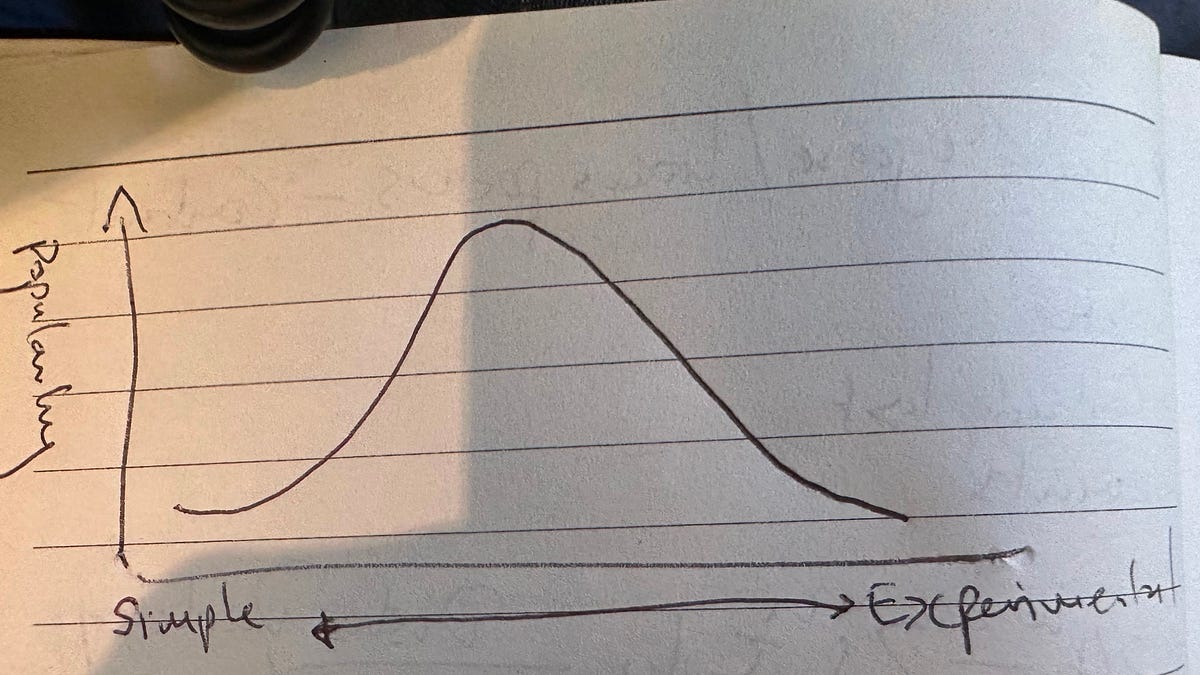
There’s a shape I keep coming back to when thinking about music and how we connect with it, a big, friendly bell curve. On the left: the musical equivalent of mashed banana, lullabies, nursery rhymes, songs with three notes and one idea. In the middle: polished pop music, catchy and comfortable. And out to the right: the strange stuff. Experimental, unpredictable, sometimes beautiful, sometimes just… bold.
As a composer, I’ve spent years dancing along that curve, writing lullabies, scoring edgy game trailers, improvising in wild, freeform ensembles. Always trying to bring something fresh, something me, to the work. Working to a brief can be limiting, but it also forces you to stay open. Curious. Responsive. It keeps you reaching toward the edges.
Thanks for reading The Quiet Room! Subscribe for free to receive new posts and support my work.
It’s not just a visual metaphor. That curve is how we listen. We tend to hang around the middle. It’s comforting. It repeats what we already know. But we need the edges. That’s where change comes from. And lately this is the bit that worries me it feels like the edges are fading.
The curve is thinning. Flattening. Tipping inward. And no, it’s not just you.
Taste isn’t just personal it’s a survival skill
There’s this idea that “taste” is some flaky, subjective thing. Like it’s just your weird preference. But taste is actually one of our most powerful tools for meaning-making. It’s how we navigate the noise. It’s pattern recognition and emotional memory rolled into one. Taste tells us what’s safe, what’s risky, what’s ours.
And here’s the thing: taste isn’t fixed. It’s learned. Shaped by time and attention and context. Something that feels jarring today might be your favourite track next month. That’s why the people playing out on the margins the experimentalists, the crate diggers, the artists who obsess over a single sound for weeks they’re the ones shifting the centre of that curve, whether we realise it or not.
That’s also why AI can’t really do it. Sure, it can generate endless variations of “music.” It can make something that sounds like it fits. But it doesn’t know what to care about. It doesn’t have a history. It doesn’t flinch. It doesn’t long for anything. That human instinct to say “this” over “that” that’s the bit that matters. That’s curation. That’s love.
We are all babies, basically
Here’s something I keep coming back to. Babies love repetition. They love the same lullaby, the same game, the same sounds in the same order. It’s not just a preference. It’s survival. Repetition helps build trust. It reassures. It tells the baby, “All is well.” And underneath that, it builds the blueprint for how they’ll relate to the world for the rest of their life.
Developmental psychologist Suzanne Zeedyk has done incredible work in this area. She talks about the deep behavioural patterns laid down in the very early years. These are shaped by how safe we feel, how we’re soothed, how we connect. These experiences quite literally form the neural architecture of the brain. Once those pathways are reinforced, they shape how we respond to everything not just as children, but as adults too.
What I find beautiful is the way she describes these early mother-child interactions. She calls them “songs.” Not literal songs, but behavioural ones. Vessels of meaning. Patterns of cooing, eye contact, soothing, responding. These songs are how we learn to communicate, to trust, to feel safe. They’re like the original compositions of our emotional lives.[
](https://substackcdn.com/image/fetch/$s_!nGPq!,f_auto,q_auto:good,fl_progressive:steep/https%3A%2F%2Fsubstack-post-media.s3.amazonaws.com%2Fpublic%2Fimages%2F9f9c5445-494c-4b93-8926-61fe904376fb_3985x820.jpeg)
So it makes sense that music, especially familiar music, has such a strong emotional pull. It mimics those early rhythms. It follows structures our brains know by heart. It becomes a semantic vessel, a container for meaning. We sing to each other long before we know how to speak. And even later in life, we keep returning to the songs that feel like home.
This is also why the early years environment matters so much. It’s not just about learning words or shapes or colours. It’s about forming the inner playlist that shapes how we relate to the world. The songs we carry with us, even if we don’t remember hearing them.
Before the record, music was alive
Most cultures in the world, especially older, pre-industrial ones, don’t even have a word for “music.” Not as a separate category. It’s part of dance, movement, ritual, story. Singing wasn’t something you watched someone else do, it was something you did.
Somewhere along the way, particularly in the West, we filtered music out. We professionalised it. You were either a “musician” or a “non-musician.” And then we turned it into a product. Something to be bought, streamed, shuffled, rated.
Before recording technology, music wasn’t a product. It was an event. It was shared. People made music together. They made it for each other. It was like storytelling. Like eating together. A form of communication. A communal language.
And yes, everyone is musical. That idea that some people are musicians and everyone else isn’t has always felt like nonsense to me. We all have the capacity. We all used to do it. Somewhere along the line, someone realised you could sell it, and that’s when things got weird.[
](https://substackcdn.com/image/fetch/$s_!WUmo!,f_auto,q_auto:good,fl_progressive:steep/https%3A%2F%2Fsubstack-post-media.s3.amazonaws.com%2Fpublic%2Fimages%2F90931c57-7fb7-4560-966b-fc671ba3c7b1_3503x2627.jpeg)
Streaming is messing with the curve
Now throw streaming into the mix. The curve used to reflect human taste in the wild. Now it’s being shaped by machines. Spotify, YouTube, TikTok they all use recommendation systems built to maximise engagement. Which usually means keep things familiar. Keep you listening. Don’t make you work too hard.
The result? A musical world that hovers around the centre of the curve. Nice. Predictable. Harmless. Pop songs that sound like other pop songs. Lo-fi beats that evaporate into your workday. Playlists that bleed into each other like wet wallpaper.
Ted Gioia has written, furiously and brilliantly, about this. How we’re being fed subpar music by recommendation systems that prioritise clicks over connection. And he’s right. Discovery has been turned into a passive drift. The thrill of finding something odd or unexpected is dulled. We don’t find the music anymore. It finds us. Quietly. Persistently. And mostly, it sounds like everything else.
When AI becomes the mirror
If generative AI is essentially a mirror a giant, ever-aging memory machine trained on the past then it’s no surprise that a lot of AI-generated music lands in the sweet spot. It fits. It flows. It sounds like something you’ve heard before, maybe because it kind of is.
As these systems get better, they don’t just imitate what’s popular. They begin to refine it, compress it, sand off the edges. They have the potential to supercharge the flattening already happening through algorithmic recommendation. What we end up with is music that’s been narrowed down to an optimised blend of harmony, rhythm, and emotional tone designed to keep us listening, but not necessarily feeling.
And it’s not just music. This flattening is happening across the board. I just watched a demo of an AI film generator a platform where you go through a menu of options: story type, narrative arc, what genre, what kind of ending, what actors. You can literally pay for specific actors to appear in your movie. Click a few buttons, pay the price of a download, and boom a film tailored to your taste, cast and all. It’s Hollywood’s generic, formula-driven content taken to its most extreme, hyper-personalised conclusion. And it’s not five years away. It’s happening now.
All the while, we’re flattening story. Flattening form. Sanding off the novelty. Removing the bits that make it art.
The extremities of the curve start to fade. Especially the right side the experimental, the dissonant, the stuff that doesn’t fit neatly into a playlist or a template. The bell curve skews inward. We’re left with a tall, skinny tower of popularity, and out on the margins, a parched tundra. Silent. Empty. Forgotten.
But it’s the unfamiliar that drives us forward. It always has been. The new, the strange, the unexpected this is the terrain of art. Of reframing. Of jolting us out of the loop and pointing toward something bigger. Art gives us the chink in the wall, the small opening into a different way of thinking.
That’s growth. That’s evolution. That’s the kernel of wisdom, the essence of existing the ability to break pattern, not just repeat it.
And this is why we need balance. Enough familiarity to feel safe. Enough novelty to grow. Without that, we don’t evolve. We just drift in circles.
If we keep heading in this direction, we might end up with a curve that looks more like a tower brittle, narrow, optimised into emptiness. But I don’t think we want that. I think, deep down, we crave the return of balance. We long for a media environment that feels human again.
Which is why we need artists. Human artists. Not just to keep making songs and films and ideas, but to keep us moving. To stretch the curve. To keep art alive at the edges.
If your playlists have started to feel a bit like hospital waiting room music, it’s probably not your imagination. But the good stuff is still out there. You just might have to go looking again.
And maybe sing a little on the way.
Thanks for reading The Quiet Room! Subscribe for free to receive new posts and support my work.