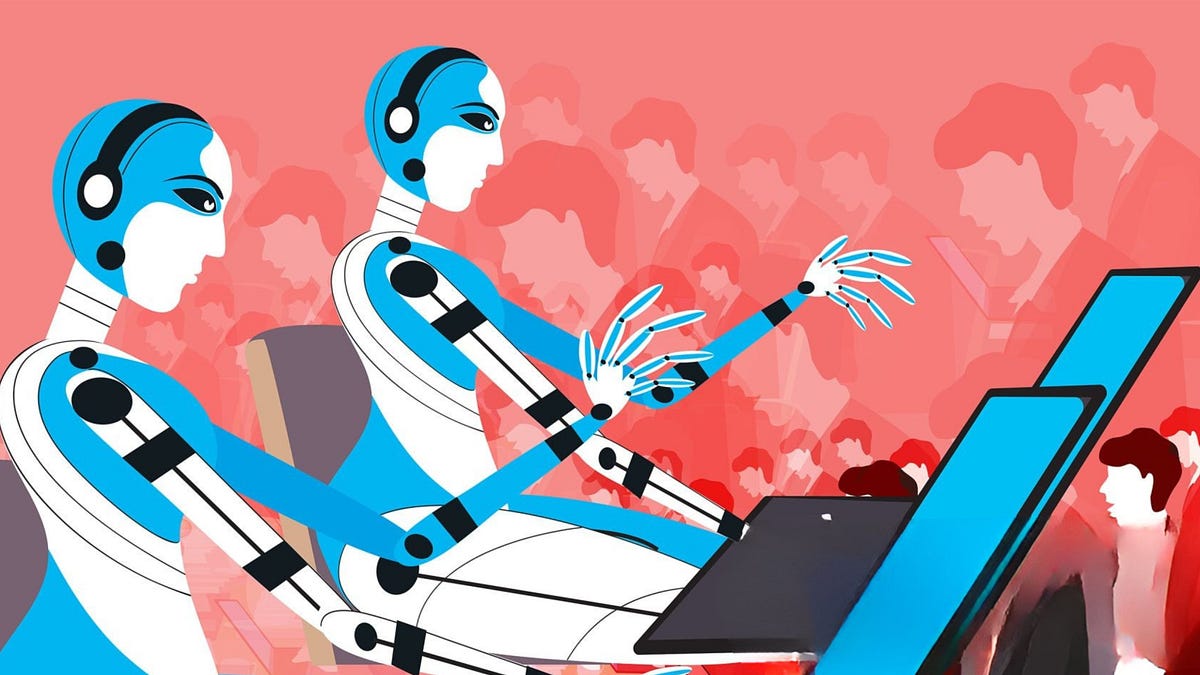
Getty Images
There’s a narrative emerging. Artists and creatives are being called on to help lead the way into the new age of artificial intelligence. We’re seen as the ones who can bring imagination, emotional intelligence and originality to a field that’s shifting fast.
But I’m not sure most artists see it that way.
Thanks for reading The Quiet Room! Subscribe for free to receive new posts and support my work.
In my experience, among the musicians, animators, writers and theatre-makers I know, AI isn’t being welcomed with excitement. It’s being met with suspicion. Often frustration. Sometimes fear. And to be honest, I understand that.
I’ve been sitting with this contradiction a lot lately. Partly because I’ve been working flat out on development projects and creative education work. It’s all been great, but I realised recently I’d barely made anything in months. I’d been reading, writing, talking, planning, producing. But not creating. Not from that place I usually go to when I’m composing.
Cue one of my regular existential spirals.
What am I doing? Who am I? Am I even an artist anymore?
And then I came across a study that reframed something for me. It looked at ADHD traits and connected them with early human survival patterns. The idea is that these traits – rapid attention shifts, high sensitivity, restlessness – were once key to survival. Especially in people who were hunters rather than gatherers.
Hunters needed to move fast. Spot patterns. Respond to changes. Know when to leave a place before resources dried up. Gatherers were more linear. They stayed longer in one place. They worked with what was in front of them.
Something about that clicked. Because to me, that’s what artists do.
We track patterns. We move between ideas. We scan the edges. We sense the emotional terrain. We gather things others overlook and reframe them into something new.
So here’s what I’ve been thinking: maybe the artist is the modern hunter.
Especially now, in a world that’s automating the predictable. We need people who can navigate ambiguity. People who can see things sideways. People who can build things that haven’t been mapped yet. That’s the creative mind. That’s the hunter mind.
But this is where the contradiction really starts to show itself.[
](https://substackcdn.com/image/fetch/$s_!YUcc!,f_auto,q_auto:good,fl_progressive:steep/https%3A%2F%2Fsubstack-post-media.s3.amazonaws.com%2Fpublic%2Fimages%2F60d0886a-0027-46f9-8844-b62b320569c9_2457x2730.jpeg)
Artists and AI: A Tense Relationship
From what I’ve seen, artists are one of the most sceptical groups when it comes to AI. And I get why.
A lot of the tools are built on scraped data. Music, art, writing, voices, performances – pulled into huge datasets without consent, credit or payment. Reassembled into something new, then sold back into the same markets the original artists rely on to make a living.
That doesn’t sit right with most people I know. It doesn’t sit right with me either.
There’s also the emotional part. Making something creative isn’t just about output. It’s about lived experience. Risk. Sensitivity. Deep listening. That part is hard to describe, and harder to replicate. When AI skips over that, it feels hollow. Like a synthetic surface without any of the weight underneath.
At the same time, I don’t think the story ends there. And recently, I’ve found myself testing some of these tools. Mostly out of curiosity. What follows isn’t a big statement – just my honest experience of trying something I thought I’d never use.[
](https://substackcdn.com/image/fetch/$s_!q3-m!,f_auto,q_auto:good,fl_progressive:steep/https%3A%2F%2Fsubstack-post-media.s3.amazonaws.com%2Fpublic%2Fimages%2Fd1338816-3fe2-4e20-b73e-79fa96a7446a_1024x1024.png)
When I Started Using It
I’ve been using AI – or what used to be called machine learning – in my work for years.
It’s been quietly embedded in tools I rely on. Mixing assistants, mastering plugins, audio repair tools, sample builders. I’ve had a kind of drum loop partner for a while. There’s an EQ plugin I trust more than some human engineers. These tools help speed up decisions. They take the pressure off. They let me focus on the things that matter to me.
I’ve always been fine with that. It feels like part of the evolution of making music with computers.
What I’ve avoided is generative music tools – the platforms that create music from scratch. That’s where I’ve always drawn a line. I’m a composer. I write music. Why would I use a tool that tries to do that for me?
Then I saw a YouTube video that caught my attention.
It was a new feature in a generative music platform. You could upload your own track and ask the system to rework it. Not just spit something random out, but take an existing piece and transform it. Change the style, texture, tone. I wasn’t expecting much. But I was curious enough to try it.
And it surprised me.
I uploaded a rough jazz-electronic hybrid I’d been building – unfinished, unpolished – and asked the system to interpret it in a new style. Urban, acoustic, a bit of brass, some vocal texture.
What came back wasn’t perfect. Some of it was way off. But parts of it really worked. It found patterns in my arrangement I hadn’t noticed. It pulled out grooves that helped the track breathe. It reshaped the rhythm in a way that added urgency and flow.
It was still my music, just filtered through another lens.
I started pulling out stems, chopping them up, dropping them into my DAW. Editing, layering, rebuilding. It reminded me of sampling, but with my own DNA. Like having a creative conversation with myself at a distance.
Even more than that, it helped me hear where I was strong – and where I needed support. I realised how often I rely on instinct, but don’t always take things across the finish line when it comes to mixing or production. The AI didn’t solve that for me, but it exposed it. It made me think about how I could strengthen the parts of my process that I usually skip past.
It didn’t feel like I was giving up control. It felt like I was expanding the process. Sampling myself, in a new way. Learning where to lean in.
Where This Leaves Me
I still have questions. Ethical ones. Creative ones. Legal ones. I don’t think the current platforms are being built with artists in mind. At least not yet.
There’s a lot of mess in the way these systems are being trained and monetised. The data, the ownership, the lack of transparency. Most of it still feels like a gold rush. That part needs to be challenged. It’s important to say that.
But I also think there’s potential here. If we can stay grounded, and stay involved, I think artists can help shape what comes next. We don’t have to surrender our process to the machines. We can build better tools. Tools that respect where ideas come from. Tools that support creativity, rather than just extract from it.
And that’s where I’m at right now.
Somewhere between caution and curiosity. Somewhere between protection and possibility. Using the tools, testing the edges, trying to figure out what this actually means for people like me who make things for a living.
Watch This Space
Over the coming weeks, I’m going to start sharing some videos that go deeper into this.
Real use cases. Tools I’ve tested. Creative results that surprised me. Where the opportunities are. And how we, as composers and music-makers, might survive and thrive in this new terrain.
More soon. Watch this space.
Thanks for reading The Quiet Room! Subscribe for free to receive new posts and support my work.