When every song, story, and image becomes personal.
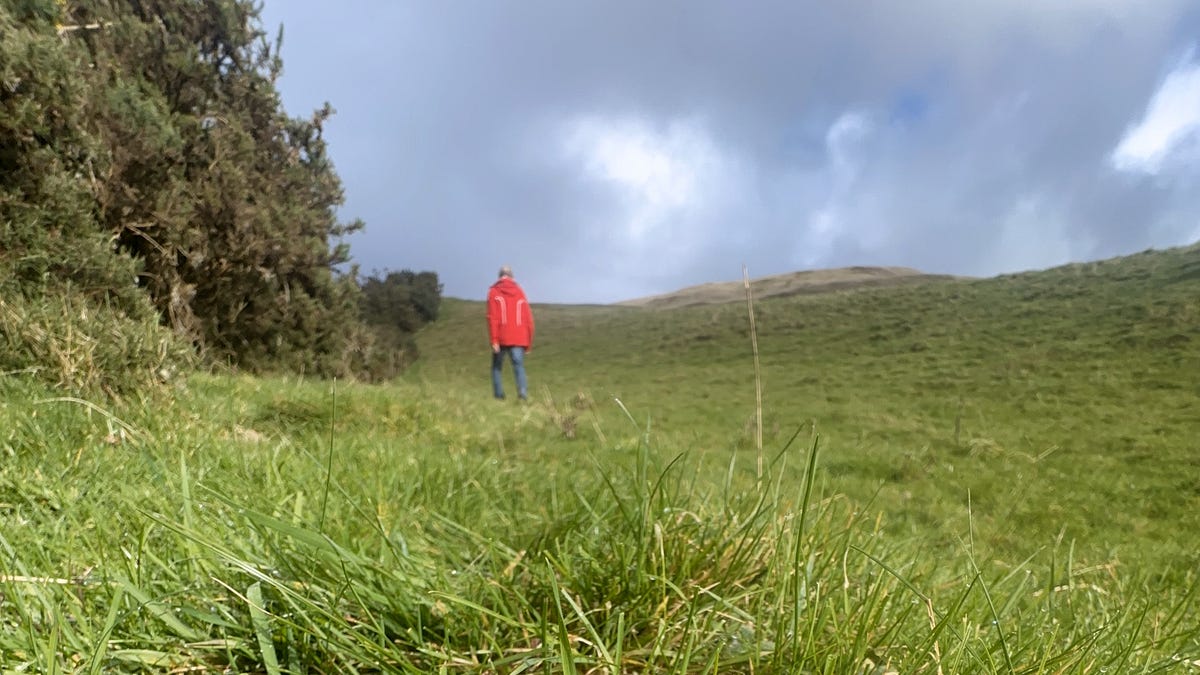
The light is breaking through the dark clouds, thin sharp bands cutting across the valley. Everything is damp from the night’s rain. The ground is soft underfoot, water running down the hill in little threads.
Thanks for reading The Quiet Room! Subscribe for free to receive new posts and support my work.
The birds are busying, darting, living.
I am walking through one of the few last remnants of ancient forest in the Yorkshire Dales, and it sings.
The trees, the stone walls, the leaves all glisten in the sudden, piercing sunlight, the air thick with the smell of wet earth.
I am alone in this autumn scene and thinking about value, about what things mean and what they are worth. It strikes me that content has lost its value, or maybe it has simply shifted. Music, images, stories have become infinite, instantly generated, woven into the air we breathe. And as a creator, it is exhausting trying to chase, monetise, and build on this quicksand. It feels like a hall of mirrors amplified by illusion.
We are entering an age where everything we see or hear will be designed for each of us, made for you and only you. Stories, songs and images that adapt to our moods, our histories, our habits. It sounds miraculous, and it is.
But it is not a question of whether AI can make art. That is the wrong question.
The real question is: do we choose to shrivel into dystopian mediocrity, or choose to be human?[
](https://substackcdn.com/image/fetch/$s_!C36k!,f_auto,q_auto:good,fl_progressive:steep/https%3A%2F%2Fsubstack-post-media.s3.amazonaws.com%2Fpublic%2Fimages%2F28ab7813-6937-4ef1-a804-3bd30253d8a4_4032x3024.jpeg)
The End of Scarcity
For as long as we have traded, we have measured value by scarcity. The rarer the thing, the more it is worth.
A handful of seeds. A manuscript. A reel of tape. A limited edition vinyl.
We built our idea of worth around the absence of abundance. If you owned the object, you held the value. The book was a thing, the record a thing, the film a thing.
Then we started copying them. And copying the copies. Until there were no things left, only streams of endlessly repeatable information.
Now content is infinite. You can ask a machine to make you a painting in the style of Turner, a symphony in the mood of Max Richter, a bedtime story told in your own voice, and it will. Instantly.
When everything can be made instantly, nothing feels precious.
When everything is new, nothing feels new.
The world of scarcity, the world that once gave meaning to creativity, has evaporated.
We used to believe the more people who heard your song, read your book, or saw your film, the more valuable it became.
Now, the more it spreads, the more it dissolves. And as creators, our work dissolves with it. We dissolve.
The harder we try, the deeper into the quicksand we go.
No wonder influencers and YouTubers are exhausted.
The Tyranny of the Head: The Unfulfilled Promise of the Long Tail
In the early days of the internet, the dream of a digital utopia was captured in Chris Anderson’s 2004 idea of the Long Tail. A world where any creator could reach a global audience instantly. A world where distribution was finally democratized.
Anderson argued that by removing the physical limitations of retail, the combined sales of niche works would rival the sales of the hits.
As he wrote:
“A Long Tail is just a culture unfiltered by economic scarcity.”
The promise was simple. Technology would eliminate the tyranny of the head.
But abundance never became democratization of reward.
The tools of production were democratized. The tools of discovery were not.
Instead we got the Revenge of the Head.
Algorithms became the new gatekeepers. The top 1 percent captured nearly all the attention and the majority of the value.
Infinite content still exists. But attention is finite. And the systems that manage attention direct it back to the centre.
We are left with the illusion of choice and the reality of scarcity at the point of reward.[
](https://substackcdn.com/image/fetch/$s_!hynT!,f_auto,q_auto:good,fl_progressive:steep/https%3A%2F%2Fsubstack-post-media.s3.amazonaws.com%2Fpublic%2Fimages%2F991a9666-e908-48e0-92da-1fc303c662a4_15562x3880.heic)
The Bedtime Story Test
A bedtime story is not about the story. It is about the voice telling it and the person listening.
The rhythm of speech. The warmth in the pauses. The small, familiar phrases that only exist between the two of you.
Meaning lives in the presence, not the plot.
It is the same with art.
A painting is not pigment.
A song is not sound.
A film is not light.
Meaning is the human breath behind it, the moment of attention, the hand reaching through the noise.
When I think about the future of art, I keep coming back to that child, half-asleep, hearing a story read by someone who loves them. Technology can reproduce every word, every tone, every flicker of the voice. It cannot reproduce care.
This is a deeper failure than technological limitation.
It is biological.
A child curled into a carer is not just listening. They are feeling the steady heartbeat and breath of another human being.
Research on heart rate variability coherence shows how two bodies can fall into shared rhythm during calm interaction. A state of synchrony. A survival instinct.
This is the ultimate evidence that the value of the moment is in the shared presence, not in the replicable content.
Care does not scale.
It is always one person to another.[
](https://substackcdn.com/image/fetch/$s_!ebUg!,f_auto,q_auto:good,fl_progressive:steep/https%3A%2F%2Fsubstack-post-media.s3.amazonaws.com%2Fpublic%2Fimages%2F8301d343-637e-4c78-8d94-2f47bf9625d2_1200x627.png)
Beyond Artificial Scarcity
The value has always been in presence.
It simply got lost in the march of progress.
We began copying art the moment we learned how. Manuscripts, printing presses, tapes, streams. More, faster, cheaper, easier. It felt like progress, and often was. But somewhere along the way, the presence fell out.
Now, in our panic to get it back, we are trying to rebuild scarcity with technology.
Minting. Tokenizing. Artificial uniqueness
It is understandable. An instinct to reintroduce friction into a frictionless world.
But it is also nostalgia. A longing to resurrect an economy that only worked when things were hard to make and simple to sell.
If we are going to find value again, we must stop treating art as a product line and start treating it as a conversation.
The new digital systems of ownership like blockchain may still matter, but not as vaults. As gathering spaces.
Not ledgers of ownership, but records of belonging.
A token could be proof that we were there, that we helped shape something as it came into being. Less a collectible, more a shared memory.
Art does not need to be rare.
It needs to be real and honest.
It needs to mean something to someone.
Designed for Each of Us
Every screen, sound and image is becoming an interface.
Media will not just show us things. It will respond to us.
Our music, news, and stories will be shaped by data drawn from us in real time. Emotion, attention, physiology.
The line between content and interface is disappearing.
The feed is no longer a stream we browse. It is a mirror that adjusts to what it reads.
Everything we see or hear will soon be tuned to us, designed for each of us and only us.
This is not science fiction. It is the next operating system.
Content will become the skin of computation, a surface we touch, speak to, and move through.
In that world, a fixed piece of art starts to look quaint.
A film or a song will feel more like a dialogue, a live response between human and machine.
Art becomes something you are inside of rather than something you observe.
But there is a problem.
We need to interface with other people, not machines.
It is a survival instinct tied to consciousness and community, woven into the way we know ourselves.
If every creative experience becomes personalised, we risk replacing connection with a simulation of connection.
We lose the shared moment, the gathering, the knowing that others saw and felt the same thing.
So the challenge is not resisting change.
It is deciding what we want to preserve.
Technology will handle the craft. The polish. The precision.
But it cannot automate intention, honesty, or empathy.
These are what make creation real.
That is the last interface that matters.
Cutting Out the Middle
For decades the creative economy has been full of middlemen.
Publishers. Distributors. Platforms. Agencies.
They built the pipes and decided what was seen, who was heard, and how much reached the maker.
We poured our work into their systems, and they sold the access back to us.
It kept the lights on, but it also meant most of the value leaked away before it reached anyone who needed it.
That is what is changing now.
AI and Web3 flatten the pipes. Creation can move directly from one person to another.
The old gatekeepers are no longer the audience.
We are.
We see the success of this in niche subscription creators.
Substack, Patreon, and similar platforms show that a creator can thrive not with ten million views but with four hundred engaged supporters who value depth, presence, and a curated experience.
This model is not about volume.
It is about connection.
So perhaps it is time to stop thinking of music, films, and stories as finished products, and start thinking of them as shared processes.
A song can be a room you invite people into.
A film can be a live experience that shifts with its viewers.
A story can be a conversation that stays open.
If someone listens, comments, contributes, remixes, or simply shows up, that is participation. That is value.
We can still use technology to track participation, but not as a transaction.
More like a map of shared experience.
The goal is not efficiency.
It is to make the line between creator and listener shorter, warmer, and more direct.
People do not want a pipeline.
They want contact.[
](https://substackcdn.com/image/fetch/$s_!C9eT!,f_auto,q_auto:good,fl_progressive:steep/https%3A%2F%2Fsubstack-post-media.s3.amazonaws.com%2Fpublic%2Fimages%2Fa25825e0-db88-4191-8a2b-1088ca6396c3_3024x4032.jpeg)
Purpose in an Automated World
If machines can do everything, what is left for us?
It is tempting to say nothing, but that is not true.
What remains are the things that make us conscious, curious, and unpredictable.
The space where intuition meets empathy.
When automation handles the labour, what remains is meaning.
Education is already shifting.
Some of the new AI-driven schools ask students to learn with machines for a couple of hours, then spend the rest of the day creating. Build a company. Design a game. Write a story.
They are not learning how to do things. They are learning how to imagine what to do next.
Knowledge can be automated.
Creativity cannot.
As the mechanical and cognitive are absorbed by AI, the human role moves upstream.
To invention, care, and consciousness itself.
Our task is not to compete with machines but to define what it means to be alive among them.
And in that world, creativity stops being leisure.
It becomes a survival skill, a way of staying human together.
What Emad Mostaque calls the last economy aligns closely with this.
In his view, AI collapses the old scarcity-based economic logic.
When intelligence becomes abundant, the only scarce resource left is consciousness.
The machines take over the work, but they cannot take over choosing what is meaningful.
And in that sense, what looks like a future skill is actually one of the oldest human arts.
We are not inventing a new economy of attention. We are returning to the way value functioned before industry turned creativity into a commodity.
Art was originally the sharing of inner experience, a way of shaping collective meaning.
As AI removes the economic necessity to produce, it reveals that this capacity for direction, discernment, presence, and expression was the real work all along.[
](https://substackcdn.com/image/fetch/$s_!fetT!,f_auto,q_auto:good,fl_progressive:steep/https%3A%2F%2Fsubstack-post-media.s3.amazonaws.com%2Fpublic%2Fimages%2F4fd2a258-bb6e-4d5f-a41e-611dcd7a3006_1384x1390.png)
The Fast Descent and the Upstream Flow
This is not a slow evolution. It is happening now.
Every month brings another leap, another shift, another compression of the gap between imagination and output.
The only thing that slows it is our ability to understand it.
For much of the world, life will continue as before.
In villages, on farms, in small towns, people will keep cooking, talking, building and repairing, bound to the rhythms of food, weather and family.
But those of us who live inside technological systems will feel the tremor first.
We built our world out of abstraction.
Screens. Data. Symbols.
We are the ones who must relearn how to be human.
And this is why art sits upstream from everything else.
Before commerce. Before infrastructure. Even before education.
There is expression.
The impulse to make, shape and share.
Creativity is not a luxury.
It is a vital organ.
It keeps the psyche porous and the spirit ventilated.
We have spent decades treating the arts as decoration, something to enjoy once the real work is done.
But maybe this shift will show us what was real all along.
Art, imagination and storytelling belong beside food, shelter and health, not beneath them.
They keep us balanced.
They remind us that value is not a number.
Value is a relationship.
Because without stories, without music, without the act of making meaning together, even the most advanced civilisation is just an efficient machine with no soul.
At the top of the hill, the wind lifts and the rain begins again, soft and deliberate.
Everything glistens. The grass. The stone. The leaves. The air itself.
None of it is scarce, yet all of it is priceless.
Maybe that is the lesson for what comes next.
Value is not something we stamp onto objects.
It appears when we meet each other, pay attention, and make meaning together.[
](https://substackcdn.com/image/fetch/$s_!9tnt!,f_auto,q_auto:good,fl_progressive:steep/https%3A%2F%2Fsubstack-post-media.s3.amazonaws.com%2Fpublic%2Fimages%2F36d8ab7e-2baa-4261-b4ba-e0a4fe597584_4032x3024.jpeg)
Thanks for reading The Quiet Room! Subscribe for free to receive new posts and support my work.