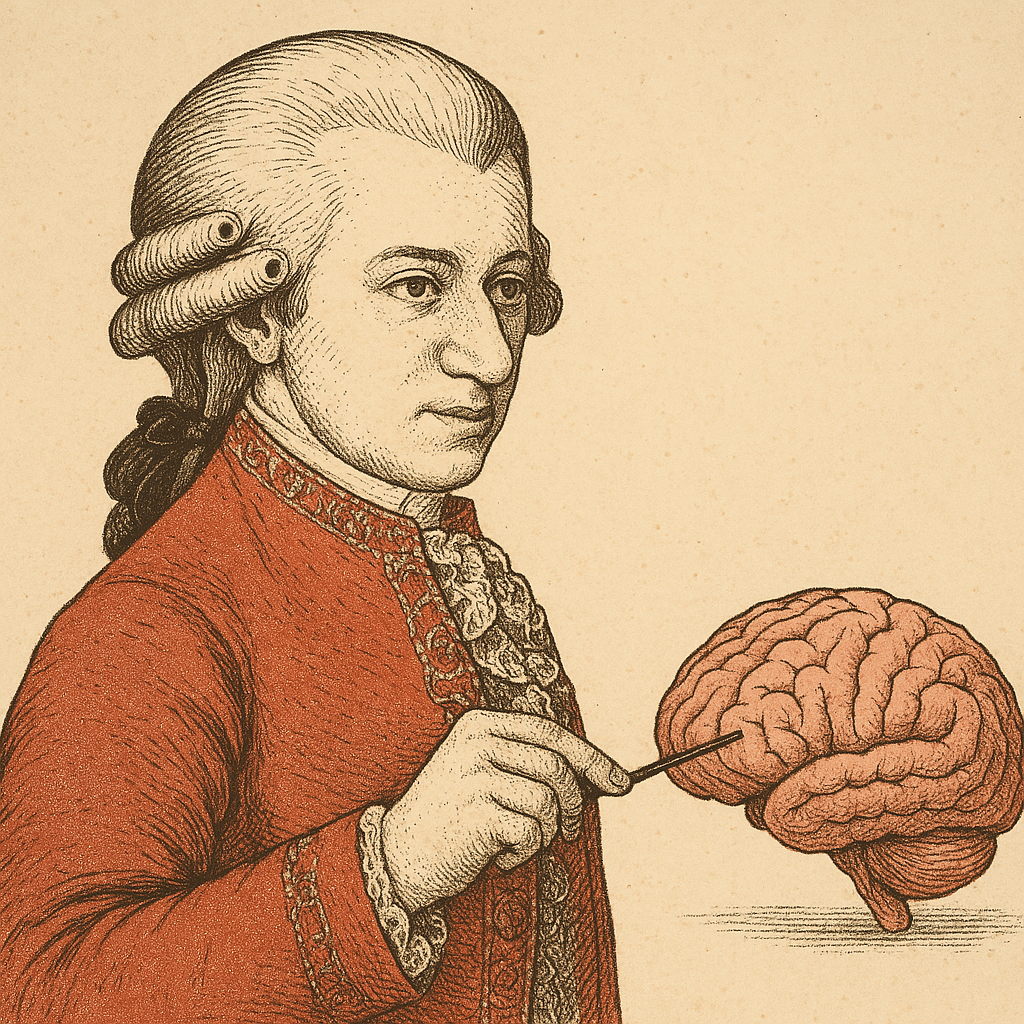
Mozart and Brain 17th Century
There was a time I believed you could prove music makes you smarter.
Like, IQ points smarter. Measurable neurons firing, brain scans lighting up like fireworks.
Mozart on the stereo. A sharpened pencil. A neatly folded IQ test.
The Quiet Room is a reader-supported publication. To receive new posts and support my work, consider becoming a free or paid subscriber.
This was the ’90s. I was at Glasgow Uni, orbiting neuroscience and psychology, trying to pass as someone who might become a scientist. Quietly pretending I wasn’t already a musician. Still clinging to the idea that logic might save me from risk.
What pulled me in were the liminal zones where mind met matter, where emotion shaped chemistry, where memory folded itself into creases of grey matter. It bugged me how little psychology and neuroscience spoke to each other. One dealt in the soft blur of dreams; the other in cold scans and clinical decline. I kept wanting to ask:
But what happens when the brain listens? When it feels?
That’s when I found the Mozart Effect.
Someone had discovered that one piece, Mozart’s Sonata for Two Pianos in D Major, gave students a short-term bump on spatial reasoning tests. The headlines wrote themselves. Classical music = brainpower. New Age gold dust in a petri dish.
I was hooked. Not just because I loved Mozart, but because it suggested something wildly hopeful: that sound could shape cognition. That the ephemeral could become empirical.
I built an experiment[
](https://substackcdn.com/image/fetch/$s_!BQ78!,f_auto,q_auto:good,fl_progressive:steep/https%3A%2F%2Fsubstack-post-media.s3.amazonaws.com%2Fpublic%2Fimages%2F337ff18c-ddaa-452f-b5bd-935b791bd160_1024x1024.png)
.
Grouped volunteers. Musicians and non-musicians.
One group listened to Mozart. One got pop. One sat in silence.
Everyone took the same battery of tests.
And the results?
Frustratingly clean.
No big swings. No Mozart miracle.
Just a spreadsheet full of statistical shrugging.
At the time, I was gutted.
But what I understand now after years of scoring animations, building sound worlds, improvising with half-broken wrists and half-recovered memories is that music was never meant to fit into tidy categories.
Science likes clean variables.
Music is all noise and nuance.
These days, my studio is equal parts lab and liminal space.
I write lullabies. I score space dreams. I explore the strange musculature of memory.
And I’m still chasing the same question:
What does music do to us?
Only now, I’m less interested in proving it.
I’m more curious about what opens up when we stop needing proof.
That said, I still keep a toe in the data pool.
And here’s the twist I didn’t see coming:
Music does change the brain just not in the ways I was looking for.
Recent research shows that making music increases neuroplasticity. Rhythmic listening enhances emotional memory and motor coordination. Even passive listening can recolour a memory change its emotional hue.
Music doesn’t just accompany feeling.
It re-authors it.
Our brains aren’t static.
Our past isn’t either.
We now know that musicians have differently shaped brains.
But more importantly: even those who don’t play those who feel deeply while listening are reshaping their minds. One note at a time.
So no, Mozart won’t raise your IQ ten points.
But he might help you grieve.
Or remember who you were at fifteen.
Or fall apart in the exact right way.
Music is not a hack.
It’s how we know we’re alive.
We sang before we spoke.
We drummed before we drew.
And even now, in dementia wards, people who’ve forgotten their families will remember a melody. That’s not an anomaly. That’s a clue.
There’s a quote I keep coming back to:
“Music is what feelings sound like.”
But maybe it’s also what the brain sounds like when it’s trying to come home.
So no my study didn’t prove anything.
But it did ask the right question.
And sometimes, that’s enough.
These days, I don’t chase results.
I chase resonance.
And every now and then, when I sit down at the keys, that old Mozart sonata plays itself back through my fingers.
Not because it makes me clever.
But because it makes me whole.
Soundtrack: Dead Island
If this essay had a soul stitched into it, this would be the sound.
🎧 *→ Dead Island *
Originally composed as the score for the Dead Island game trailer, this piece somehow became much more than a soundtrack. It struck a chord, quietly, profoundly and found its way into people’s lives in unexpected ways. It’s been played at weddings. At funerals. It’s wrapped itself around moments of loss and connection, grief and joy.
What’s wild is that it began as a one-take improvisation. No grand plan. No edits. Just a moment of honesty at the piano. Something simple and universal, unpolished and true.
That’s the thing about music: the rawest offerings are sometimes the ones that echo longest.
If you need proof, just read the YouTube comments.
Music for Reconnection
Anti-brain-rot. Anti-numbness. Pro-feeling.
Listen to a piece of music while doing absolutely nothing else. Let it flood you.
Revisit a song from your teens. Notice what stirs. Bonus points for cringe and tears.
Make a playlist called “My Brain Remembering Itself.” Five songs. No overthinking.
Improvise something. Even if it’s just breath and table taps.
Share a song with someone. Say why. Be specific. Be soft.
Take a walk with ambient music. Let it reframe the world.
Return to silence. Just for five minutes. Listen to the afterglow.
Want to explore more personal stories behind your music in future pieces? Drop a link or a memory. Let’s follow the sound.
The Quiet Room is a reader-supported publication. To receive new posts and support my work, consider becoming a free or paid subscriber.