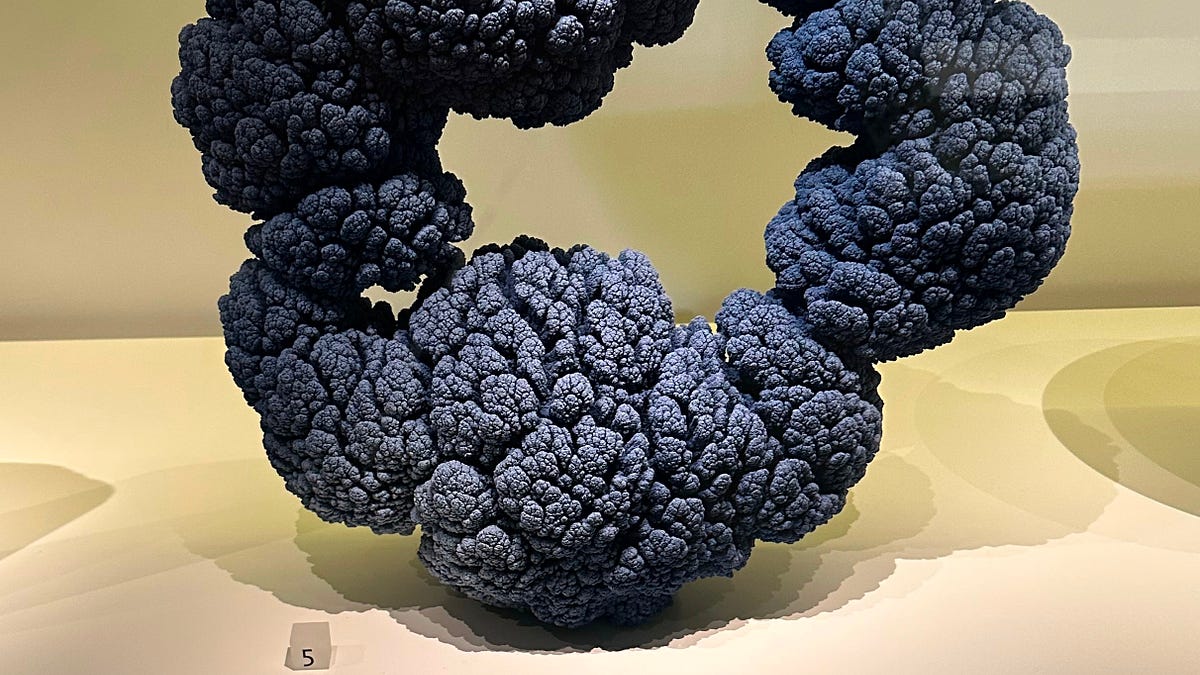
'Living in the Fog', 2024, Aizawa Rie's uniquely textured sculptures resemble living organisms like coral reefs. She made this work by spraying porcelain slip mixed with blue pigment onto a hand-built body with an air compressor. She then fired the piece several times to bring out the delicate colour gradations, repeating both steps until the bubbled surface emerged. In 2024, she won a Bronze Award at the 13th International Ceramics Competition Mino, Japan.
“We are not thinking machines that feel, we are feeling machines that think.”
, Antonio Damasio
On Monday I was at Dundee Inspiration Day, hosted by Immersive Arts at the CoSTAR Realtime Lab. Bright building. Screens. Coffee. Conversations about what art could be when it refuses the hurry.
Sophie Crocket of Crossover Labs spoke about immersive art as an empathy machine. A space that lets the audience stay inside a feeling rather than moving past it. That stayed with me, because almost everything around us says finish, deliver, optimise, ship.
I think the real value comes from not finishing. Or from finishing slower. From living inside the messy middle for as long as possible.
When I write music it is never about chasing a final result. Composition for me is improvisation in real time. Each note makes me feel something. That feeling pulls me to the next note. A cascade. A red thread.
I play, I listen back, I find fragments that resonate. I rework, reshape, rewrite passages. Sometimes I zoom out to see how it fits, sometimes I let it hang loose. Then later I record, tweak, edit. Even in electronic music production the same thing happens. The work tells me when it is ready, not the deadline or brief.
This is the state I am most alive in, the open and shifting space before the work is done.
The Red Thread of Fate is an image from East Asian mythology. In Japanese “Unmei no Akai Ito” it is an invisible thread said to connect people destined to meet. It may stretch or tangle but it never breaks.
I like to borrow that image for creativity. Every fragment, every connection between notes or words is a red thread. Not in a romantic sense but in a creative sense. If we stay open, if we follow curiosity, the universe delivers strange connections, chance encounters, happy accidents. Serendipity is not random. It happens when we are awake enough to notice.
Antonio Damasio’s work explains why this matters. His somatic marker hypothesis shows that emotions guide decisions. Feeling is not an afterthought, it is the compass.
When we create we are in a loop with those feelings. We play something, feel something, and respond. That loop is where originality lives.[
](https://substackcdn.com/image/fetch/$s_!wo1l!,f_auto,q_auto:good,fl_progressive:steep/https%3A%2F%2Fsubstack-post-media.s3.amazonaws.com%2Fpublic%2Fimages%2F42d6bb41-f67f-459b-8ea7-679fac613dae_1024x1024.jpeg)midjourney, 2025: circular loop of glowing light flowing between an artist figure and a translucent audience silhouette, representing emotional resonance, dreamlike, ethereal atmosphere, soft diffused lighting, minimal palette, concept art, abstract but human, cinematic composition, sense of movement, high detail, 16:9
Brian Eno has warned that technology can make things too tidy too quickly. It tempts us to polish before we have wandered. And wandering is where accidents become breakthroughs. Where dissonance becomes harmony. Where fragments turn into stories.
Brené Brown’s Atlas of the Heart argues that naming what we feel is what makes connection possible. Creativity works the same way. We have to stay inside the process long enough to notice what feels alive, what feels flat, what feels unresolved.
Biologist Stuart Kauffman calls this the adjacent possible, the set of options available to you from where you stand right now. Each step opens a new set of possibilities, but you only find them if you keep moving.
Sometimes this is called the red thread, the invisible line that pulls one idea to the next. Following it requires patience and attention. It is not a plan. It is a practice.
Finishing too soon is the cheap version. It might look polished but it flattens the energy and kills surprise. The pressure to ship and deliver is not neutral. It shapes what we make, what we allow, what we cut away.
A sketch stays alive only when I refuse to kill it too early. A melody becomes something else only when I leave room around it. A track becomes moving only when the editing comes after living with it.
Damasio reminds us that feeling is intelligence at work.
Brené Brown reminds us that naming what we feel creates connection.
Brian Eno reminds us that friction and imperfection are what make the work original.
Together they point to something quietly radical:
The work is not just the thing you finish. The work is what happens while you are still in it.
If You Want to Go Deeper
Some books and ideas that connect with this theme referenced in Sophie’s talk.
Descartes’ Error – Antonio Damasio
The Feeling of What Happens – Antonio Damasio
Atlas of the Heart – Brené Brown
A Year with Swollen Appendices – Brian Eno
Oblique Strategies – Brian Eno and Peter Schmidt
The Adjacent Possible – Stuart Kauffman
Art & Fear – David Bayles and Ted Orland
Show Your Work – Austin Kleon
And here is your permission slip:
Make mistakes. Many of them. Mistakes are not failures. They are the process showing you where to go next. They are the sparks that lead to discovery.
If you start with the end result in mind, what you are making is no longer art. It becomes assembly. True art is the process of not knowing, of searching, of letting the work reveal itself. The finished piece is not the point. It is a trace, a byproduct, an echo of the real art, which is the act of discovery itself.[
](https://substackcdn.com/image/fetch/$s_!D5RX!,f_auto,q_auto:good,fl_progressive:steep/https%3A%2F%2Fsubstack-post-media.s3.amazonaws.com%2Fpublic%2Fimages%2Fbfa97b21-c2b4-47cb-b37d-1bc756abe230_2219x1579.jpeg)Los Moscos (2004) by American artist Mark Bradford.
I sometimes feel a little cold in front of all these incredible new immersive technologies. The 360 video, the spatial sound, the hyperreal experiences. They are technically astonishing, yet they can sometime feel a little hollow. They have immersion but not heart, spectacle but not warmth. They are driven by what they can do, not by an underlying process, a human connection, a need to tell or reveal something true
This is why it matters that we do not use technology for its own sake. Do not start with the tool and force the idea to fit it. Let the process lead and let the tools reveal themselves as you go. When technology grows out of the work, it becomes invisible, almost effortless, supporting the story instead of overwhelming it.
Hold the work open a little longer. Keep reworking. Keep listening. Let it breathe. Let the next step appear in its own time.
Because the point is not to deliver something on time. The point is to discover what only this process, only this moment, only this version of you could have uncovered.
That is where resonance lives. That is where the work becomes alive.